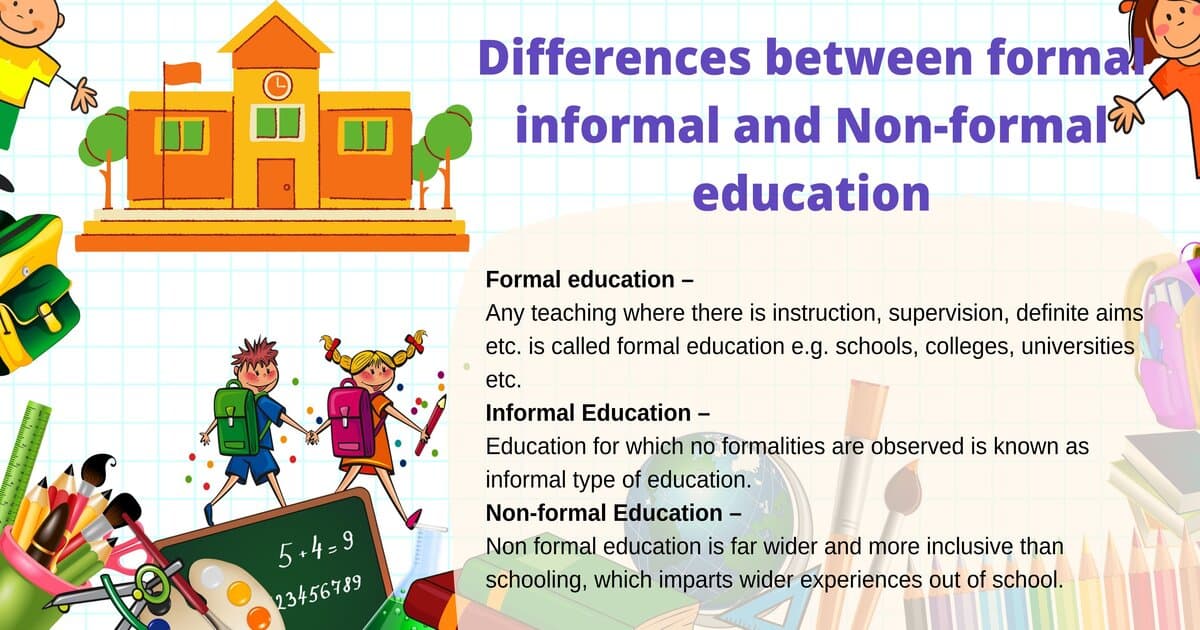
Differences between formal informal and Non-formal education
by Yuvi - November 15, 2020
Differences between Formal education, Informal education and Non-formal education –
1. Meaning :-
Formal education –
Any teaching where there is instruction, supervision, definite aims etc. is called formal education e.g. schools, colleges, universities etc.
– It is limited to a specified period.
– It is consciously received education for which deliberate efforts are made.
Informal Education –
Education for which no formalities are observed is known as informal type of education. It is a casual type of education which is received through daily experiences and activities. .
-Here education is received by the company of friends, relatives, community etc.
Non-formal Education –
Handersons-view:- “Non formal education is far wider and more inclusive than schooling, which imparts wider experiences out of school.”
McCall’s view: “Non formal education is the entire range of learning experiences outside of the regular graded school system.”
Harbuism’s view: “Non-formal education is the only means of filling the gap between the ‘schooled’ and ‘unschooled’ population”. It is midway between both formal & informal. e.g. open school, open clinic etc..
2. Goal
Formal Education –
In this type of education, specific aims are well fixed in advance.
Informal Education –
In this type of education, there are no pre-determined aims.
Non-formal Education –
It has clear cut aims in sight.
3. Age limit
Formal Education –
It is started at a particular age, is continued and thus over the years it is completed. Start is not possible at all stages of age.
Informal Education –
There is no age limit for the start or completion of this type of education. It is never going and never ending process.
Non-formal Education –
No age limit. A person of any age group can enter in this setup and continue his studies. .
4. Result
Formal Education –
Its result is always good education because everything is pre-planned and the process of education goes on under supervision.
Informal Education –
It may result into negative learning because the leaner may acquire certain bad habits, wrong attitudes etc.
Non-formal Education –
Its result is sometimes good and sometimes not good, because it is partly formal and partly informal. .
5. Work schedule
Formal Education –
Work-schedule is fixed .
Informal Education –
No work schedule is fixed for it.
Non-formal Education –
Work-schedule is fixed.
6. Rules and regulations
Formal Education –
Rules and regulations are there. Obedience of those is mandatory for all the learners of that school.
There are no rules and regulations. So there is no question of obedience of those rules and regulations.
Non-formal Education –
Sometimes rules and regulations are observed. It is based upon part time and own time table.
7. Restrictions
Formal Education –
Restricted type of freedom is given to the learners and the teacher.
All freedom is given to the teachers and the learners.
Non-formal Education –
No restrictions are observed. It is self imposed or inner discipline.
8. Organizing body
Formal Education –
It is always organized type of education, some organized body is behind the establishment of the school.
Informal Education –
It is unorganized of education. There is no organized body behind or in the background.
Non-formal Education –
Here, there is an organized body behind or in the background.
9. Time bond
Formal Education –
Syllabus is completed through the formal type of education.
Informal Education –
There is no syllabus and so there is no question of completing the syllabus.
Non-formal Education –
There is a syllabus here and time period is defined to complete the syllabus.
10. Time table
Formal Education –
There is always a formal type of time table in vogue during the process of teaching-learning.
Informal Education –
No time table is fixed. Things happen out of chance or by mere luck as they say.
Non-formal Education –
In this type of education, time-table is fixed, but there not rigid, flexible time-table is there.
11. Syllabus
Formal Education –
There is prescribed syllabus always.
Informal Education –
There is no prescribed syllabus here.
Non-formal Education –
There is prescribed syllabus always.
12. Place
Formal Education –
The school is at a fixed place.
Informal Education –
Here place is not fixed to impart the education.
Non formal Education –
Here place is fixed for some time.
13. Qualification of teacher
Formal Education –
Only a qualified person can act as a teacher and his duty is to impart education.
Informal Education –
Anybody may act as a teacher in a situation. Even a student may sometimes, play the role of a teacher in some situation.
Non formal Education –
Here qualified person is required to impart education. In other hand, electronic medias are used also, to impart education.
14. Process of teaching
Formal Education –
It is artificial way of teaching-learning.
Informal Education –
It is natural type of teaching learning.
Non formal Education –
It is both natural as well as artificial for sometimes.
15. Role
Formal Education –
Conscious efforts are made both by the teacher and the learner in the process of teaching-learning.
Informal Education –
No conscious efforts are made by the teacher and the learner.
Non formal Education –
Here learner is more active than teacher. Conscious efforts are made by the both but learner is more active.
16. Means
Formal Education –
Proper means are used to achieve the goals.
Informal Education –
No proper means are used.
Non-formal Education –
Proper means are used but to some extent.
17. Mental strain
Formal Education –
It leads to mental strain.
Informal Education –
Informal education being natural does not strain the learner.
Non-formal Education –
It involves only limited mental strain. .
18. Set-up
Formal Education –
It is a formal type of set-up. Here all type of formalities are observed.
Informal Education –
Here no formalities are observed.
Non-formal Education –
It is partly formal and partly informal.
19. Entry
Formal Education –
It has fixed point of entry and exit.
Informal Education –
There is no question of entry and exit in informal education.
Non-formal Education –
It has flexible points of entry and exit, re-entry and re-exit throughout the life.


 Pin It


![Taxmann’s Bharatiya Criminal Laws – Bare Acts [Hindi] COMBO [Bharatiya Nyaya Sanhita (BNS) | Bharatiya Nagarik Suraksha Sanhita (BNSS) | Bharatiya Sakshya Adhiniyam (BSA)]](https://www.yogiraj.co.in/wp-content/uploads/2026/05/Taxmanns-Bharatiya-Criminal-Laws-–-Bare-Acts-Hindi.jpeg)
![Taxmann’s Criminal Laws Combo [Diglot Edition] – Bharatiya Nyaya Sanhita (BNS) | Bharatiya Nagarik Suraksha Sanhita (BNSS) | Bharatiya Sakshya Adhiniyam (BSA)](https://www.yogiraj.co.in/wp-content/uploads/2026/05/Taxmanns-Criminal-Laws-Combo.jpeg)