Projective techniques
by Yuvi - March 6, 2022
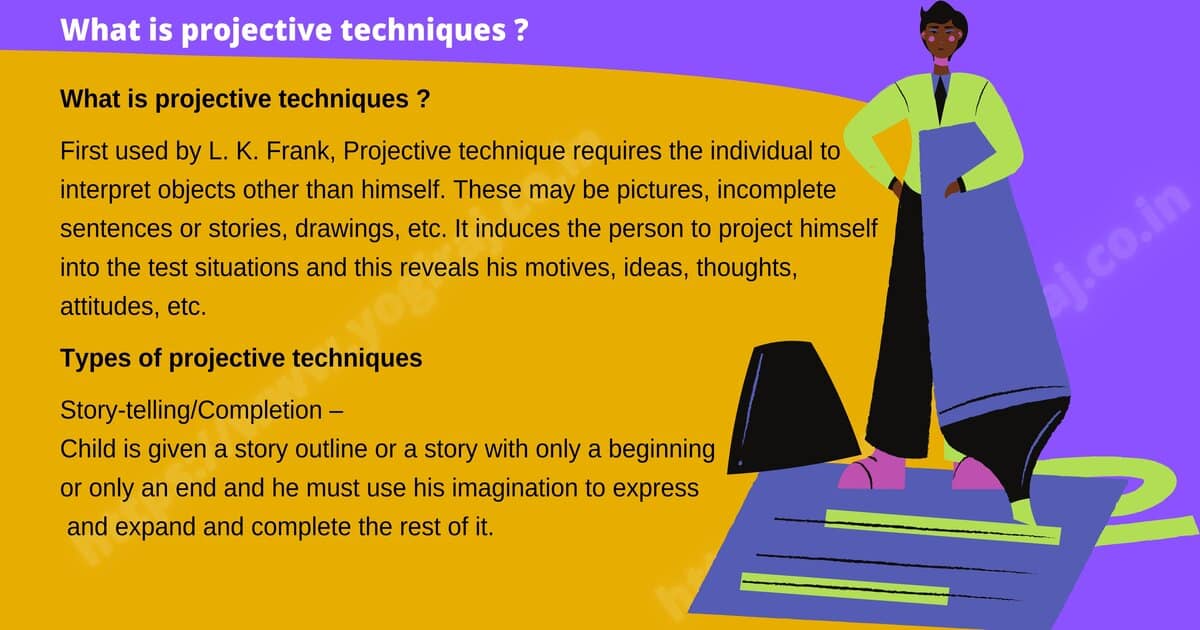
What is projective techniques ?
First used by L. K. Frank, Projective technique requires the individual to interpret objects other than himself. These may be pictures, incomplete sentences or stories, drawings, etc. It induces the person to project himself into the test situations and this reveals his motives, ideas, thoughts, attitudes, etc.
Types of projective techniques
Story-telling/Completion –
Child is given a story outline or a story with only a beginning or only an end and he must use his imagination to express and expand and complete the rest of it.
His innermost thoughts, his feelings, desires, imagination, creativity all are unconsciously reflected in his descriptions.
Sentence Completion –
Child is given incomplete sentences and asked to complete them. Analysis of the answers provides insight into the childs ideas, healthy/unhealthy attitudes, conflicts, etc.
Eg. My mother _ _ _ _
My best friend _ _ _ _ _
I feel hurt when _ _ _ _ _
Drawing and Paintings –
Spontaneous behavior and works of art of the child are observed. They reveal their personality through choice of theme, colours, open spaces, curvature of lines, length, direction, etc.
Eg. Drawing a house will be completed in different ways by different children. Some may draw windows, some may not, some may show a garden surrounding it, some may show a car standing outside, etc.
Other kinds –
Dream analysis, Rorschach Ink-Blot, Role-Play, Diary, Thematic Appreciation Test, Child Appreciation Test, etc.
Merits of projective techniques –
- Reliable as subject is not aware of the fact that he is revealing information about his self.
- Subject cannot fake his reaction as he does not know the actual purpose of the test.
- It is a free and unrestricted way to get a total view of the person’s personality.
- Not necessary for the subject to possess literary or academic skills. So very useful with young children, illiterates, persons with language or speech handicaps.
- Preserve unity and integrity of the total personality.
Limitations of projective techniques –
- Well-trained psychologists are required to administer and interpret these tests.
- Time-consuming.
- Subjective in nature.
- Difficult to interpret and very few standardised tests available.


 Pin It



![Taxmann’s Bharatiya Criminal Laws – Bare Acts [Hindi] COMBO [Bharatiya Nyaya Sanhita (BNS) | Bharatiya Nagarik Suraksha Sanhita (BNSS) | Bharatiya Sakshya Adhiniyam (BSA)]](https://www.yogiraj.co.in/wp-content/uploads/2026/05/Taxmanns-Bharatiya-Criminal-Laws-–-Bare-Acts-Hindi.jpeg)
![Taxmann’s Criminal Laws Combo [Diglot Edition] – Bharatiya Nyaya Sanhita (BNS) | Bharatiya Nagarik Suraksha Sanhita (BNSS) | Bharatiya Sakshya Adhiniyam (BSA)](https://www.yogiraj.co.in/wp-content/uploads/2026/05/Taxmanns-Criminal-Laws-Combo.jpeg)