Difference between western ghats and eastern ghats
by Yogi P - December 25, 2024
Western and Eastern Ghats
India is home to the diversity and various geographical features, two important mountain ranges among them are named Western Ghats and the Eastern Ghats. They play an important role in creating the climate of our country, biodiversity, and culture.
While these both Ghats are important to the ecosystem of the India, they differ in several aspects, like location, structure, climate, and flora and fauna. We will discuss these differences here in detail and explore the facts.
Location and Geography of Western and Easter Ghats
Western Ghats: These mountains are stretching parallel to western coast of India, and running through the states of Maharashtra, Goa, Karnataka, Kerala, and Tamil Nadu. These are a continuous range which begins near Gujarat and ends at Kanyakumari.
Eastern Ghats: The Eastern Ghats run along Eastern coast of India, crossing Odisha, Andhra Pradesh, Tamil Nadu, and a part of Karnataka. Unlike the Western Ghats, the Eastern Ghats are fragmented and discontinuous, consisting of isolated hill ranges.

Location and Geography of Western and Easter Ghats
Elevation and Structure Ghats
Western Ghat mountains are higher and more uniform, with peaks like Anamudi (2,695 m) and Doddabetta (2,637 m) being among the tallest. The Western Ghats have a steep Western slope as well as a gentler Eastern slope.
The Eastern Ghats mountains are lower in elevation, with peaks like Arma Konda (1,680 m) and Jindhagada Peak (1,690 m). The structure of Eastern Ghats is more irregular due to erosion and river valleys.
Climate of Western and Eastern Ghats
Western Ghats: Due to south-western monsoon they receive heavy rainfall, with regions like Munnar and Agumbe recording some of the highest rainfall in the country.
Eastern Ghats: Rainfall is comparatively less in Eastern Ghats as compared to Western Ghats, as they are less exposed to the monsoon winds. The climate is comparatively drier, and the vegetation is sparse in comparison to the Western Ghats.
Biodiversity in Western and Eastern Ghats
Western Ghats: Recognized as a UNESCO World Heritage Site, the Western Ghats are a biodiversity hotspot. They are home to tropical rainforests, unique wildlife species, and medicinal plants. Animals like the lion-tailed macaque, Malabar civet, and Nilgiri tahr are found here.
Eastern Ghats: Though Eastern Ghats are rich in flora and fauna, they are less biodiverse. They host species like the Indian bison, leopards, and sloth bears, and are home to forests ranging from dry deciduous to moist deciduous types.
Rivers
Western Ghats: Many west-flowing rivers like the Mandovi, Zuari, and Periyar originate here, flowing into the Arabian Sea.
Eastern Ghats: Mainly the east-flowing rivers like the Godavari, Krishna, and Kaveri pass through the Eastern Ghats, draining into the Bay of Bengal. These rivers are longer and more navigable.
Agriculture and Human Settlement in Ghats
Western Ghats: Western Ghats have fertile soil and the lots of rainfall make this region suitable for cultivating crops like coffee, tea, spices, and rice. Human population is dense in the foothills and valleys.
Eastern Ghats: With a comparatively drier climate, this region supports agriculture mostly like millets, pulses, and oilseeds. Population density is less dense as compared to the Western Ghats.
Cultural Significance of Ghats
Western Ghats: The Western Ghats have many important ancient temples, hill stations, and pilgrimage sites like Sabarimala and Sringeri. Due to beautiful scenic beauty Western Ghats are also a major tourist destinations in India.
Eastern Ghats: The Eastern Ghats are having more culturally significant temples like Tirupati and Lingaraja Temple. Mostly the Tribal communities are playing an important role in preserving the cultural heritage of this region.
Key Differences Between Western and Easter Ghats at a Glance
| Feature | Western Ghats | Eastern Ghats |
|---|---|---|
| Location | Western coast | Eastern coast |
| Elevation | Higher, continuous | Lower, fragmented |
| Rainfall | High | Moderate to low |
| Biodiversity | Rich (UNESCO World Heritage Site) | Moderate |
| Rivers | Short, west-flowing | Long, east-flowing |
| Agriculture | Tea, coffee, spices | Millets, pulses, oilseeds |
Conclusion
The Western and Eastern Ghats, are distinct, but are the integral part of natural and cultural landscape of India. They together contribute to the ecological balance, agriculture, and cultural heritage of the India. Knowledge of their differences in important to highlights their unique roles and to understand the need for their preservation.


 Pin It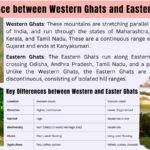



![Taxmann’s Bharatiya Criminal Laws – Bare Acts [Hindi] COMBO [Bharatiya Nyaya Sanhita (BNS) | Bharatiya Nagarik Suraksha Sanhita (BNSS) | Bharatiya Sakshya Adhiniyam (BSA)]](https://www.yogiraj.co.in/wp-content/uploads/2026/05/Taxmanns-Bharatiya-Criminal-Laws-–-Bare-Acts-Hindi.jpeg)
![Taxmann’s Criminal Laws Combo [Diglot Edition] – Bharatiya Nyaya Sanhita (BNS) | Bharatiya Nagarik Suraksha Sanhita (BNSS) | Bharatiya Sakshya Adhiniyam (BSA)](https://www.yogiraj.co.in/wp-content/uploads/2026/05/Taxmanns-Criminal-Laws-Combo.jpeg)