Difference Between Sale and Agreement to Sell
by Yogi P - December 15, 2024
Difference Between Sale and Agreement to Sell
As we know that both sale and an agreement to sell involve transferring of a property from one person to another for a price. But there are significant differences between them in terms of timing and legal implications.
In a sale, ownership is transferred immediately and the buyer becomes the legal owner as soon as the price for the goods is paid. On the other hand, an agreement to sell only shows the intention to transfer ownership in the future. Ownership is not transferred immediately.
For instance, when you “buy” an under-construction flat and pay a token amount, you’re actually entering into an agreement to sell. The real sale doesn’t happen until the construction is complete and the full payment is made. Until then, the builder still owns the property. It’s important to know the difference because these two concepts carry different legal consequences.
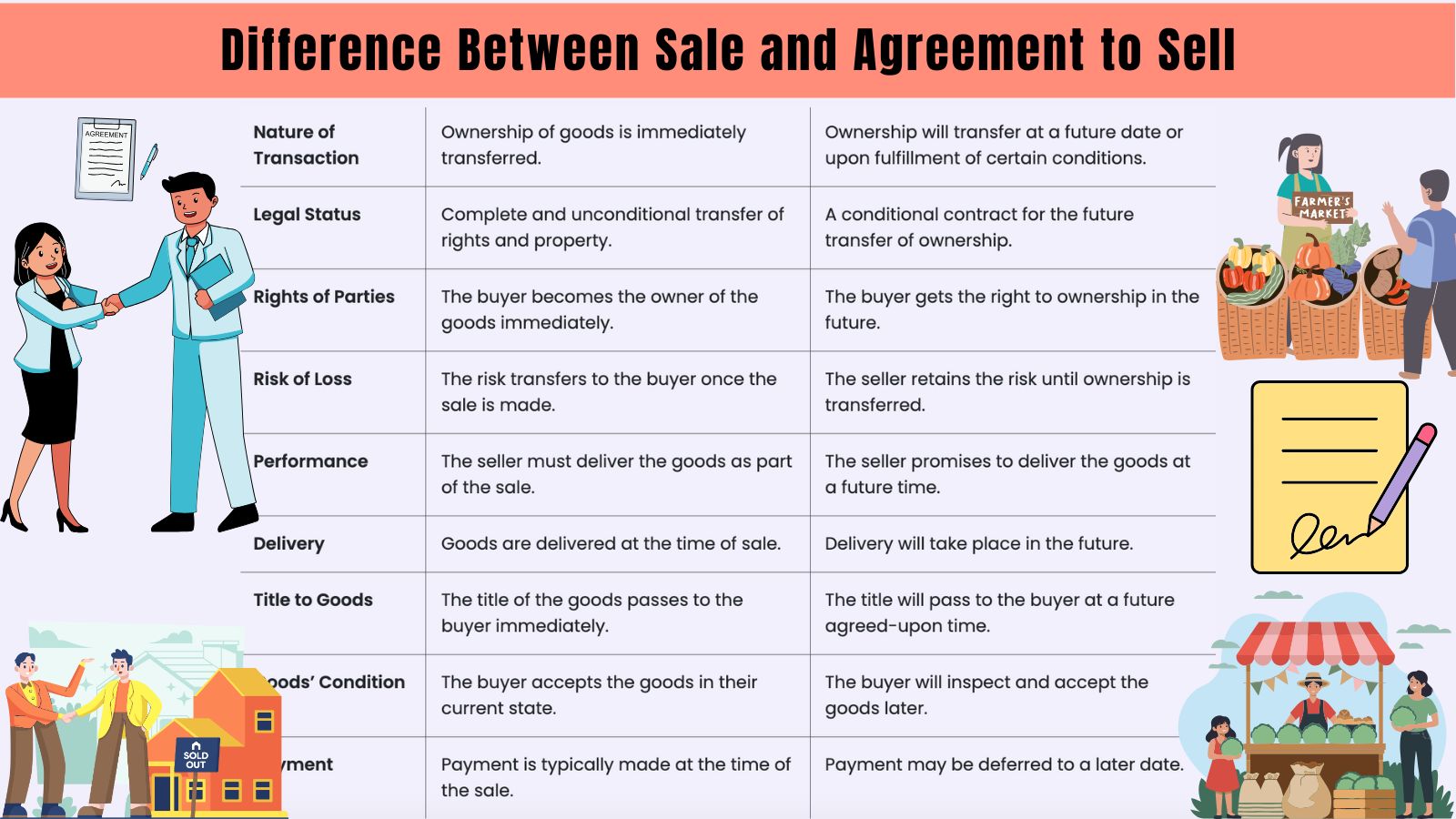
Table of Difference Between Sale and Agreement to Sell
| Aspect | Sale | Agreement to Sell |
|---|---|---|
| Nature of Transaction | Ownership of goods is immediately transferred. | Ownership will transfer at a future date or upon fulfillment of certain conditions. |
| Legal Status | Complete and unconditional transfer of rights and property. | A conditional contract for the future transfer of ownership. |
| Rights of Parties | The buyer becomes the owner of the goods immediately. | The buyer gets the right to ownership in the future. |
| Risk of Loss | The risk transfers to the buyer once the sale is made. | The seller retains the risk until ownership is transferred. |
| Performance | The seller must deliver the goods as part of the sale. | The seller promises to deliver the goods at a future time. |
| Delivery | Goods are delivered at the time of sale. | Delivery will take place in the future. |
| Title to Goods | The title of the goods passes to the buyer immediately. | The title will pass to the buyer at a future agreed-upon time. |
| Goods’ Condition | The buyer accepts the goods in their current state. | The buyer will inspect and accept the goods later. |
| Payment | Payment is typically made at the time of the sale. | Payment may be deferred to a later date. |
| Ownership | Ownership of the goods is transferred instantly. | Ownership is transferred at a future point in time. |
| Legal Remedies | The buyer can claim damages for breach of contract. | The buyer can sue for specific performance if the agreement is not honored. |
| Insolvency | Goods are not part of the seller’s assets in case of insolvency. | Goods may be claimed by the seller’s creditors until ownership is transferred. |
| Risk of Destruction | Risk of goods is borne by the buyer after the sale. | The seller bears the risk until ownership is transferred. |
| Termination | A sale cannot usually be canceled unless mutually agreed upon. | The agreement can be terminated under certain conditions or by mutual consent. |
| Possession | Possession of goods is transferred immediately to the buyer. | Possession may be retained by the seller until a later date. |
| Title Defects | The buyer receives goods with a clear title. | There is a possibility of title disputes or defects until transfer is completed. |
| Return of Goods | The buyer typically cannot return the goods after the sale is completed. | Goods may be returned under the terms of the agreement. |
| Warranty | The goods are sold with implied warranties unless stated otherwise. | Warranties may or may not be part of the agreement. |
| Effect of Future Events | Future events do not affect the sale contract. | Future events, like performance issues, can impact the agreement. |
| Liabilities | The seller is liable for defects or damages present at the time of sale. | The seller’s liability for future damages depends on the agreement terms. |
| Passing of Property | Property rights transfer at the time of sale. | Property rights transfer later, based on agreed terms. |
| Revocation | Revocation is typically not possible without mutual consent. | The agreement may be revoked under specific conditions. |
| Confidentiality | No confidentiality obligations are usually present in a sale. | Confidentiality clauses may be included in the agreement. |
| Ownership Disputes | The buyer’s ownership cannot usually be challenged post-sale. | Ownership may be subject to disputes until the transfer is finalized. |
| Specific Performance | Specific performance is not typically enforced unless explicitly agreed upon. | The buyer can request specific performance of the agreement if breached. |
| Third-Party Rights | Third parties cannot claim rights to the goods once sold. | Third parties may claim rights if the agreement is not fulfilled. |
| Legal Formalities | No specific legal formalities are generally required for a sale. | Legal formalities may be required to validate the agreement. |
| Risk Allocation | Risk transfers to the buyer once the sale is completed. | Risk remains with the seller until ownership is transferred. |
| Time of Contract | The contract is concluded at the time of sale. | The contract is initiated with the agreement and completed later. |
| Statutory Provisions | Governed by laws related to the sale of goods. | Governed by laws specific to agreements for the future sale of goods. |
Also Read: Specific Performance: A major remedies in Contract Enforcement
What is a Sale?
A sale is a simple exchange of ownership of goods from a seller to a buyer in return of a price paid or promised to be paid in the future. This process is relatively quick – in this the buyer pays, and the seller hands over the goods or property.
For example, when you purchase a book from a store, you pay the price, and the book is yours right then and there. The sale is complete as soon as the transaction happens, it means the ownership is immediately transferred.
The key element of a sale is that it is a immediate and complete transfer of ownership from one person to another person. The buyer gets immediately what they paid for, and the seller is no longer responsible for the goods. There is no waiting involved in this, and both parties are clear about the terms, like the price and the delivery of the goods.
Advantages of a Sale
- Immediate Ownership
With a sale, you don’t have to wait for getting the goods for which you have paid, and you will get it as soon as sale is complete. - Clear Terms, No Surprises
Everything is already decided before the sale like price, product, delivery etc. So it is like what you see is what you get. - Seller Gets a Break
Once the sale is done, the seller is no more responsible for that sold goods. - Instant Cash for the Seller
When the sale is complete, the seller gets their cash straight away. - Transfer of responsibility
Once the sale is finished, responsibility of the goods lay on the buyer and seller is not responsible for it any more now. So, if that thing gets lost, broken, or decides to spontaneously combust, it’s on them, not the seller. - Easy Peasy Paperwork
Sales are simple to document. You just need a receipt and maybe a sales contract, and voilà, you’ve got your records sorted. No complicated spreadsheets needed.
Disadvantages of a Sale
- Selling Too Cheap Can Hurt
Sometimes, you might sell something for less than it’s worth, especially during a big sale. If the price is too low, the business might lose out on profit. Oops. - It Doesn’t Always Equal Big Profits
Sure, sales can bring in lots of customers, but they don’t always mean the business is raking in cash. If the discounts are too steep or marketing costs are high, the profit margins might be smaller than expected. - It Can Decrease the Coolness Factor
If everything is constantly on sale, customers might stop thinking your product is super special. They’ll just wait for the next discount, and that original price tag won’t look so appealing anymore. - Customers Get Used to Discounts
If you keep offering great sales, customers might start expecting a bargain every time. So, when you do try to sell something at full price, they might wonder if something’s wrong with it. “Why is it so expensive? Is it broken?” - It Might Make Your Brand Look Desperate
If you’re always having sales, it can give the impression that you’re struggling. People might start thinking your products are lower quality or that you’re just trying to unload stuff. Yikes. - Inventory Woes
Sales can lead to a sudden rush of customers, which is awesome… until you run out of stock. Then, you’re stuck with empty shelves and frustrated buyers who just wanted their new thing. Or worse—too much stock sitting around, and now you’ve got to figure out what to do with it.
What is an Agreement to Sell?
An agreement to sell is basically a promise that a sale will happen in the future, but only when certain conditions are met. Ownership doesn’t change hands right away. Instead, it’s postponed until everything outlined in the agreement is fulfilled. Think about when you book an apartment that’s still under construction. You’re not the owner yet—it’s just an agreement. Once the apartment is completed and all conditions are met, the sale is finalized, and ownership is transferred to you.
Advantages of Agreement to Sell?
- Time to Work Things Out
With an agreement to sell, both sides have time to finalize details. This works especially well if the transaction is complex or depends on future events. - Clarity and Protection
Setting clear conditions up front protects both the buyer and the seller. It’s a way to avoid misunderstandings and ensure everyone knows what’s expected. - Chance to Double-Check
It also gives everyone time to inspect the goods or property. Whether it’s verifying documents or checking the quality of items, due diligence helps avoid surprises later. - Seller Stays in Control
Until the deal is done, the seller keeps ownership. This is handy if they need assurance that the buyer will meet their obligations before parting with their property. - Time for Preparations
Sometimes, sales need milestones to be met—like getting permits or approvals. Agreements like this allow time for those steps without rushing. - Better Price Potential
Sellers might lock in a better deal by negotiating in advance, especially if they can demonstrate the true value of what’s being sold.
Disadvantages of an Agreement to Sell
- Uncertainty
The deal isn’t guaranteed until all conditions are met. If things don’t go as planned, delays, or worse could happen. - Risk of a Breach
Either side could fail to meet their commitments, causing disputes or even legal issues. That’s why it’s so important to have clear terms in writing. - Seller’s Responsibility Stays
While waiting for the sale to go through, the seller is still responsible for risks like damage or loss. This can be stressful if things drag on. - Changes in Market Conditions: Over the course of an agreement to sell, the market can shift. This means the value or demand for the goods or services might change, and the agreed price could no longer match what’s happening in the market. This can make it harder to close the deal on terms that both parties find fair.
Key Differences Between Sale and Agreement to Sell
When it comes to a contract for goods, generally the people mix up “sale” and “agreement to sell.” While these both are essential in commercial business, they aren’t the same at all. Let us check the key differences between these two.
Ownership Transfer
In a sale, ownership of the goods transfers right away from the seller to the buyer. It’s immediate and final. But in an agreement to sell, this transfer happens in the future, often depending on certain conditions being met.
Risk and Responsibility
With a sale, once the goods belong to the buyer, so do the risks – damages, loss, or anything else becomes their responsibility. On the other hand, in an agreement to sell, those risks stay with the seller until ownership officially passes.
Legal Standing
A sale is a done deal – it’s a fully executed contract. Meanwhile, an agreement to sell is a promise. It’s not complete until the ownership changes hands, making it a work-in-progress contract until then.
What Happens if Things Go Wrong?
In a sale, if the seller goes bankrupt or defaults, the buyer can still claim the goods since they already own them. However, in an agreement to sell, the buyer’s rights are limited because ownership hasn’t passed yet—they’re treated more like an unsecured creditor.
Price Changes
If the price of the goods fluctuates after a sale, it’s the buyer’s concern, as they already own the goods. But for an agreement to sell, price changes before the transfer might require renegotiation between both parties.
In essence, a sale is all about the here and now, while an agreement to sell is a handshake for the future.
Also Read: Difference Between Agreement and Contract
Similarities Between Sale and Agreement to Sell
Though the timing and conditions differ, sale and agreement to sell share a lot in common because, at their core, both are contracts involving the transfer of goods:
It’s All About Agreement
Both require a willing seller and buyer who agree to exchange goods for money. It’s a mutual understanding.
Clear Terms Are Key
For either to work, there has to be an offer and acceptance—clear terms on the price, delivery, and the condition of the goods. Without this, the deal can’t hold up.
Capacity to Contract
Both parties must be legally and mentally capable of entering into the contract. You can’t have a valid agreement otherwise.
Enforceable by Law
Whether it’s a sale or an agreement to sell, both are enforceable under commercial laws, provided all terms are met.
Paperwork and Taxes
Keeping proper records is essential for both. Also, taxes or duties often apply regardless of whether it’s a sale or an agreement to sell.
Shared Legal Foundations
Both rely on the same basic principles of contract law: mutual consent, consideration (payment), and legality.
In short, while the timing and execution might vary, the foundation of a sale or an agreement to sell is built on similar principles of fairness and clarity.
Wrapping It Up
An agreement to sell is useful for situations where you need more time or want to ensure everything is in place before making the final deal. But it does come with risks, like delays and market changes. To make it work smoothly, it’s crucial to lay out clear terms that both parties can agree on. With the right planning, it can be a win-win for everyone involved.


 Pin It


![Taxmann’s Bharatiya Criminal Laws – Bare Acts [Hindi] COMBO [Bharatiya Nyaya Sanhita (BNS) | Bharatiya Nagarik Suraksha Sanhita (BNSS) | Bharatiya Sakshya Adhiniyam (BSA)]](https://www.yogiraj.co.in/wp-content/uploads/2026/05/Taxmanns-Bharatiya-Criminal-Laws-–-Bare-Acts-Hindi.jpeg)
![Taxmann’s Criminal Laws Combo [Diglot Edition] – Bharatiya Nyaya Sanhita (BNS) | Bharatiya Nagarik Suraksha Sanhita (BNSS) | Bharatiya Sakshya Adhiniyam (BSA)](https://www.yogiraj.co.in/wp-content/uploads/2026/05/Taxmanns-Criminal-Laws-Combo.jpeg)