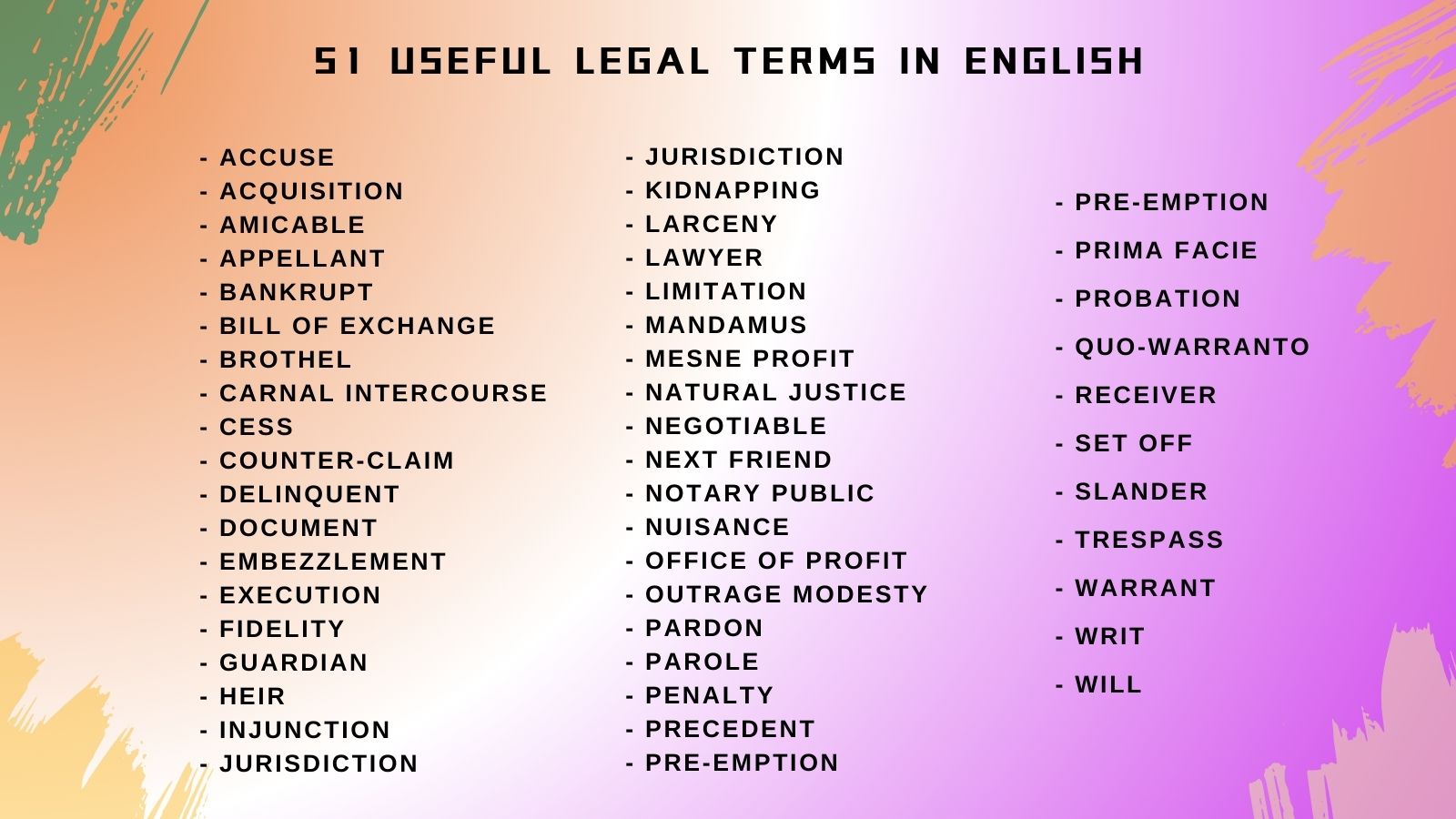
51 Useful legal term of law in English
by Yogi P - August 4, 2024
Useful legal terms of law in English
Accuse: To charge with an offence.
Acquisition: The act of getting or of becoming the owner of any property.
Amicable: Friendly.
Appellant: Person making an appeal.
Bankrupt: An insolvent person.
Bill of exchange: A written order by drawer to drawee to pay sum on a given date to drawer or to named payee.
Brothel: A house appropriated or used for the purpose of prostitution.
Carnal intercourse: Sexual intercourse.
Cess: An assessment, tax or levy.
Counter-claim: A claim set up against the plaintiff in a same suit being based on a cause of action.
Delinquent: A person who fails in his duty or commits an offence.
Document: A legal deed or piece of writing, something that furnishes evidence.
Embezzlement: Dishonest misappropriation of property by a person who comes in possession of it.
Execution: The process of carrying into effect a court decree or judgment.
Fidelity: Faithfulness or loyalty.
Guardian: A person legally appointed to take charge of the person or property of another.
Heir: A person who inherits or is entitled to inherit property.
Injunction: A judicial order restraining a person from beginning or continuing an action.
Jurisdiction: The authority of a court to hear and decide cases.
Kidnapping: Taking away a person against their will.
Larceny: Theft of personal property.
Lawyer: One whose profession is to conduct lawsuits or to advise on legal matters.
Limitation: A statutory specification of a period within which an action must be brought.
Mandamus: A prerogative order issued to compel the performance of a duty of a public or quasi-public nature.
Mesne profit: The profit which a person in wrongful possession of property actually received or might receive.
Natural justice: Justice based upon the moral feelings of mankind.
Negotiable: Capable of being negotiated, transferable or assignable in the course of business from one person to another.
Next friend: A person who is admitted or appointed by a court as a special guardian to act for the benefit of a minor or any person not sui juris.
Notary public: A public officer whose function is to certify signatures and documents on oath.
Nuisance: Anything injurious or obnoxious to the community or to an individual as a member of it for which some legal remedy may be found.
Office of profit: An office which is capable of yielding pecuniary gain.
Outrage modesty: To infringe modesty of another.
Pardon: The excusing of a fault, a remission.
Parole: A conditional and revocable release of a prisoner serving an unexpired sentence in a penal institution.
Penalty: A sum agreed to be paid on breach of an agreement or some stipulation in it, money recoverable by virtue of a penal statute, punishment imposed by any breach of law.
Precedent: A previous case taken as an example or justification of a rule to be followed in subsequent cases.
Pre-emption: A right to purchase property before or in preference to other persons.
Prima facie: Based on the first impression.
Probation: A system of releasing on suspended sentence during good behavior young persons and especially first offenders and placing them under the supervision of a probation officer who acts as a friend and adviser.
Quo-warranto: An order by which any person who occupies or usurps an independent substantive public office or franchise or liberty is asked to show by what right he claims it.
Receiver: One who receives, one who has been appointed by court to receive and conserve property that is the subject of litigation, to administer it under the supervision of the court as its agent and to apply, manage and dispose it of in accordance with the orders and decrees of the court.
Set off: An item or amount which is or should be set off against another in the settlement of accounts, a counter claim or a counter balancing debt pleaded by the defendant in an action to recover the money due.
Slander: Defamatory words spoken of another.
Trespass: Doing of unlawful act or of lawful act in unlawful manner to the injury of another’s person or property or any violation or transgression of the law, to enter unlawfully upon another’s land or ground.
Warrant: A writ or order issued by some authority empowering an officer to make an arrest, seizure or search or to execute a judicial sentence.
Writ: A written command, precept, or formal order issued by a court directing or enjoining the person or persons to whom it is addressed to do or refrain from doing some act specified therein.
Will: A person’s formal declaration in writing of his intention as to the disposal of his property or other matters to be performed after his death.


 Pin It




![Taxmann’s Bharatiya Criminal Laws – Bare Acts [Hindi] COMBO [Bharatiya Nyaya Sanhita (BNS) | Bharatiya Nagarik Suraksha Sanhita (BNSS) | Bharatiya Sakshya Adhiniyam (BSA)]](https://www.yogiraj.co.in/wp-content/uploads/2026/05/Taxmanns-Bharatiya-Criminal-Laws-–-Bare-Acts-Hindi.jpeg)
![Taxmann’s Criminal Laws Combo [Diglot Edition] – Bharatiya Nyaya Sanhita (BNS) | Bharatiya Nagarik Suraksha Sanhita (BNSS) | Bharatiya Sakshya Adhiniyam (BSA)](https://www.yogiraj.co.in/wp-content/uploads/2026/05/Taxmanns-Criminal-Laws-Combo.jpeg)