90 legal terms in English | Legal Language, Writing and General English
by Yogi P - August 3, 2024
Legal Language, Writing and General English
Accomplice: One concerned with another or others in the commission of offence.
Act: A law made by a competent legislature. Accused: A person against whom an allegation has been made that he has committed an offence or who is charged with an offence.
Adjournment: The act of adjourning.
Affidavit: A written statement in the name of a person called the deponent by whom it is voluntarily signed and sworn to or affirmed.
Appeal: A proceeding taken before a superior court or authority for reversing or modifying a decision of a lower court or authority on grounds of error.
Averment: The action of averting.
Champerty: The offence of assisting a party in a suit in which one is not naturally interested with a view to receiving a share in the disputed property.
Cognizable: Capable of being taken cognizance.
Consent: A concurrence of will.
Eviction: Ejection.
Hypothecation: Pledging or pawning. A lien on property.
Inheritance: Succession by descent.
Intestate: Without leaving a will.
Innuendo: An allusive or depreciatory remark, insinuation.
Judgement: A judicial decision or order in court, a judicial decision or order given or pronounced by the court.
Legitimacy: The quality of being a legitimate child.
Lien: A right by which a person in possession of the property holds and retains it against the other in satisfaction of a demand due to the party retaining it.
Malafide: In bad faith.
Maintenance: Maintaining, a subsistence, offence of aiding a party in litigation without lawful cause.
Minor: A person who has not attained majority.
Preamble: The introductory part of a statute, ordinance or regulation that states the reasons and intent of law or regulation.
Remand: The act of sending back a prisoner into custody. The act of sending back a case or suit or an appeal to the lower court or authority for re-hearing.
Repeal: Abrogation of any law.
Res judicata: A case or suit already decided.
Respondent: A party called upon to respond or answer a petition, a claim or an appeal.
Restitution: The act of restoring or a condition of being restored. Restoration of a person, thing or institution to its former position, status or form.
Statute: A written law as distinguished from a customary law or law of use and want. A legislative enactment.
Ultra-vires: Beyond one’s power or authority.
Vis-major: Superior force.
Voidable: That may be avoided or declared void, though not ab initio void.
Abstract: Gist, summary.
By-election: An election to fill a casual vacancy.
Confession: The action of confessing or acknowledging one’s guilt.
Fiduciary relations: Relation in trust or confidence.
Review: A general survey or reexamination.
Revision: The act of examination again in order to remove any mistake.
Revocable: Capable of being revoked.
Abandon: To give up.
Abate: To put an end to.
Abduction: The action of abducting.
Abrogate: To abolish by official, authoritative or formal action.
Absolute: Unqualified; free from external restraint or limitation.
Acknowledgement: The action acknowledge the done or given in recognition of something received.
Acquittal: Deliverance from a charge; a judicial discharge.
Actionable: Affording ground for an action at law.
Adverse: Opposing, acting in a contrary direction.
Admonition: An expression of authoritative warning. A gentle reproof to a convict in lieu of punishment.
Adulteration: The action of adulterating.
Affray: Breach of the peace by fighting or riot. Public brawl, noisy fight.
Ambiguous: Open to more than one meaning.
Amendment: The action or result of amending. An alteration made or proposed by adding, deleting or substituting something.
Annul: To make void or of no effect.
Apprehension: Being apprehended or seized in the name of justice on authority, anticipation.
Arrest: To restrain or detain a person by lawful authority.
Attestation: The act of attesting.
Bail: Temporary release from imprisonment on furnishing surety or security to appear for trial.
Bailment: Delivery of goods in trust.
Bar: Barrister & advocates collectively. That which obstructs entry or egress, excluding from consideration.
Bigamy: Entering into a marriage with one person while still legally married to another. Having two wives or husbands at once.
Burden of proof: Obligation to prove one’s assertion.
Cause of action: The fact or combination of facts which gives rise to a right to sue.
Caveat: A legal notice given by an interested party to some officers not to do a certain act until the party is heard in opposition.
Certiorari: A writ issuing from a superior court calling up the record of a proceeding in an inferior court for review.
Coercion: An application to another of such force either physical or moral as to constrain him to do against his will something he would not otherwise have done.
Condone: To forgive or overlook.
Confession: The action of confession or acknowledging one’s guilt.
Damages: The sum claimed or awarded in compensation for loss or injury sustained.
Deponent: One who deposes or gives evidence, a witness.
Easement: Right of the owner or occupier of a property in respect of another’s property for beneficial enjoyment.
Endorsement: A writing on the back of a document.
Fair and just: Proper and justified.
False personation: Falsely pretending to be some other person.
Garnishee: A person in whose hands a debt is attached.
Habeas Corpus: A writ to a jailor to produce a prisoner in person before the court and to state the reason for detention.
Illegal: Contrary to law.
Injustice: Unjust action.
Jurisdiction: Legal authority or power.
Juvenile: Young, youthful.
Lawful: According to or not contrary to law.
Malfeasance: An official misconduct; evil doing.
Negligence: Want of proper care, want of attention to what ought to be done or looked after, lack of proper care in doing something.
Offence: A crime, an act or omission punishable by law.
Pauper: A person destitute of means except as are derived from charity.
Ratification: Approval by word or conduct of that which was improperly or unauthorizedly performed in the first instance, confirmation, formal sanction.
Settlement: A decision of a question, dispute etc., the act of deciding disputes between parties.
Tort: A civil wrong independent of contracts.
Unlawful: That which is contrary to law.


 Pin It



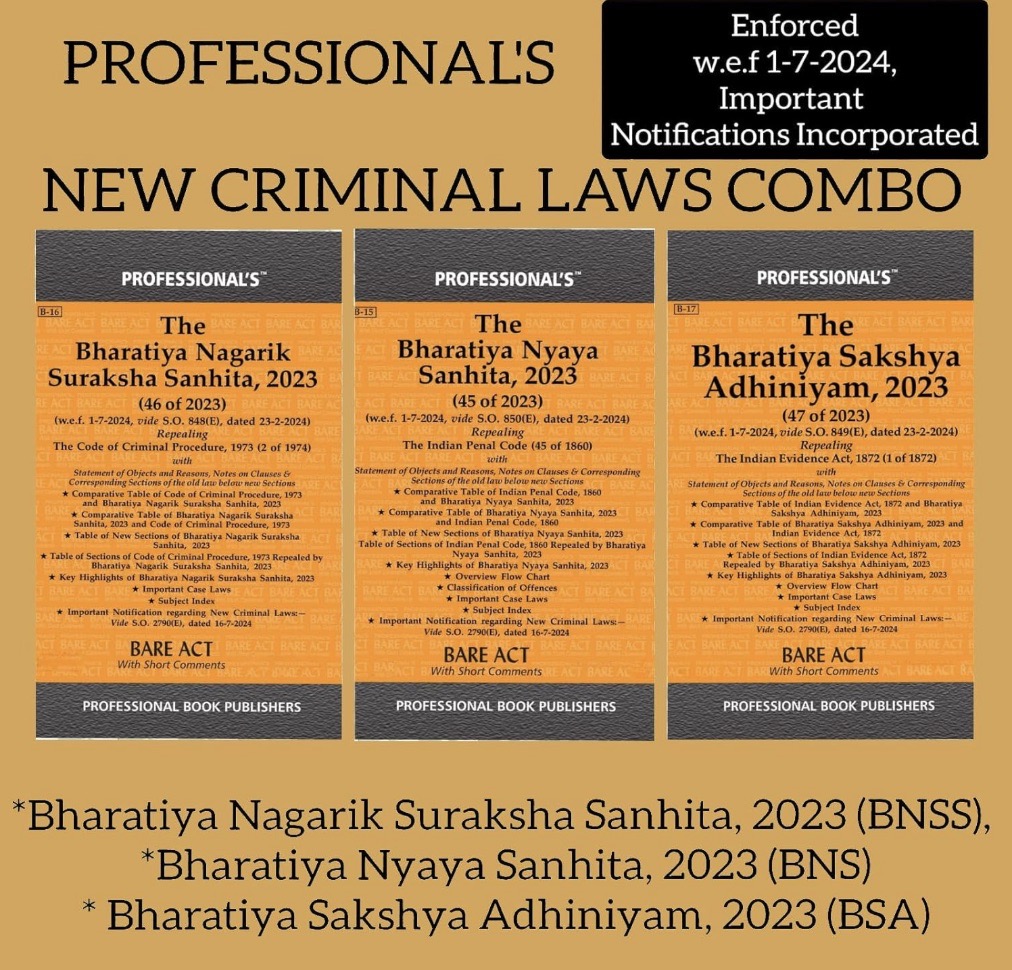
![Taxmann’s Bharatiya Criminal Laws – Bare Acts [Hindi] COMBO [Bharatiya Nyaya Sanhita (BNS) | Bharatiya Nagarik Suraksha Sanhita (BNSS) | Bharatiya Sakshya Adhiniyam (BSA)]](https://www.yogiraj.co.in/wp-content/uploads/2026/05/Taxmanns-Bharatiya-Criminal-Laws-–-Bare-Acts-Hindi.jpeg)
![Taxmann’s Criminal Laws Combo [Diglot Edition] – Bharatiya Nyaya Sanhita (BNS) | Bharatiya Nagarik Suraksha Sanhita (BNSS) | Bharatiya Sakshya Adhiniyam (BSA)](https://www.yogiraj.co.in/wp-content/uploads/2026/05/Taxmanns-Criminal-Laws-Combo.jpeg)