Roman Numerals
by Yogi P - December 20, 2024
What is Roman Numerals system?
Roman Numerals system is a unique system developed by the Romans, by combining additive and subtractive principles. In this numeral system, specific letters from the Latin alphabet are used to represent base numbers, which can be combined to express a wide range of numerical values.
For an example, XLVIII Roman numerals represent the number 48. Roman numerals continue to be used in various contexts, such as naming school classes (e.g., Class I, Class X) etc.
What Are Roman Numerals?
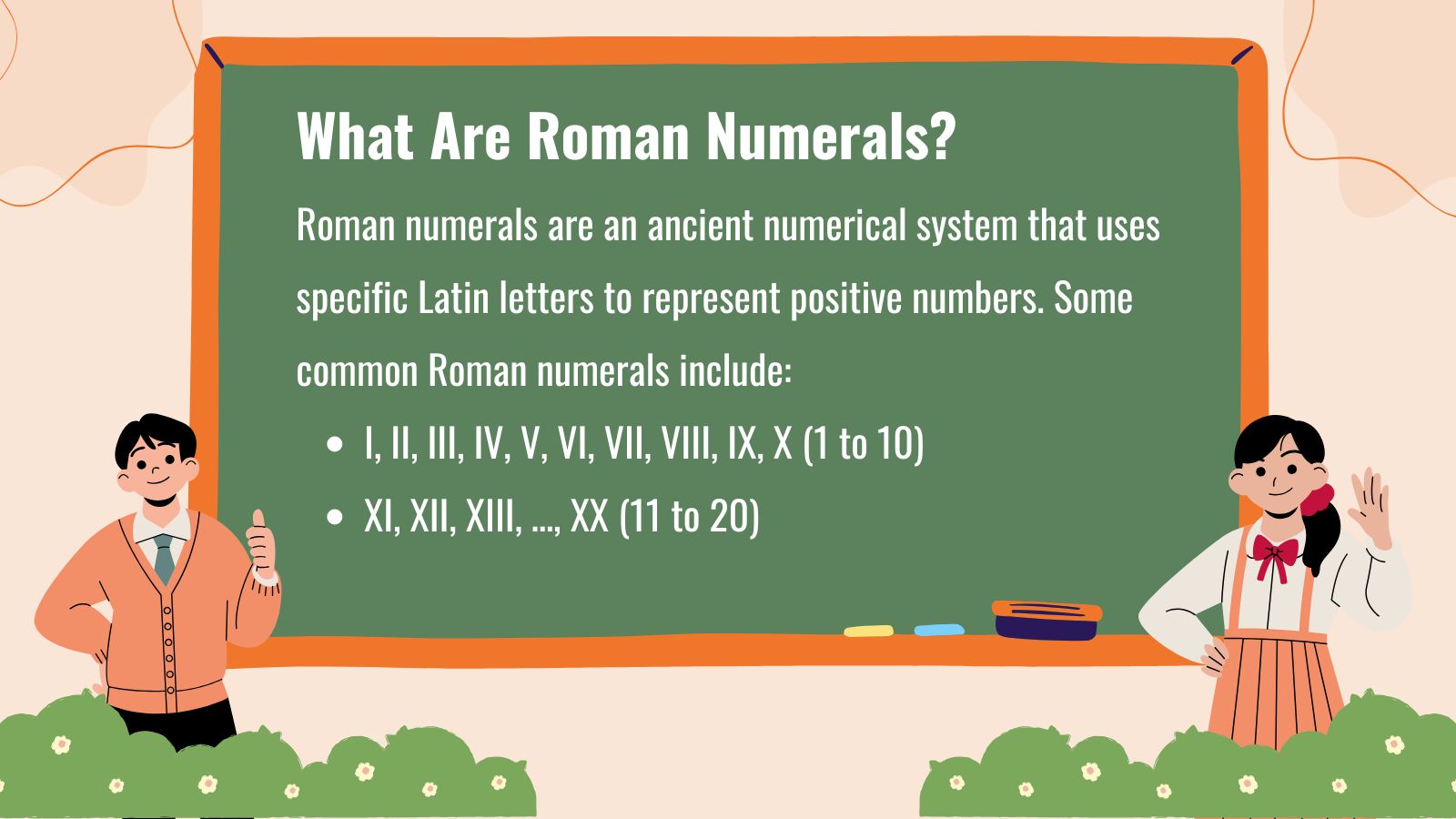
Roman numerals are an ancient numerical system that uses specific Latin letters to represent positive numbers. Some common Roman numerals include:
- I, II, III, IV, V, VI, VII, VIII, IX, X (1 to 10 in Arabic Numbers)
- XI, XII, XIII, …, XX (It is 11 to 20 in Number system)
Below is the set of standard Roman numeral symbols and their values:
| Symbol | Value |
|---|---|
| I | 1 |
| V | 5 |
| X | 10 |
| L | 50 |
| C | 100 |
| D | 500 |
| M | 1000 |
Roman Numerals Chart (1 to 1000)
The chart below shows Roman numerals for key numbers, making it easier to learn and use this numeral system.
Roman Numerals from 1 to 100:
| 1 | I | 35 | XXXV | 69 | LXIX |
| 2 | II | 36 | XXXVI | 70 | LXX |
| 3 | III | 37 | XXXVII | 71 | LXXI |
| 4 | IV | 38 | XXXVIII | 72 | LXXII |
| 5 | V | 39 | XXXIX | 73 | LXXIII |
| 6 | VI | 40 | XL | 74 | LXXIV |
| 7 | VII | 41 | XLI | 75 | LXXV |
| 8 | VIII | 42 | XLII | 76 | LXXVI |
| 9 | IX | 43 | XLIII | 77 | LXXVII |
| 10 | X | 44 | XLIV | 78 | LXXVIII |
| 11 | XI | 45 | XLV | 79 | LXXIX |
| 12 | XII | 46 | XLVI | 80 | LXXX |
| 13 | XIII | 47 | XLVII | 81 | LXXXI |
| 14 | XIV | 48 | XLVIII | 82 | LXXXII |
| 15 | XV | 49 | XLIX | 83 | LXXXIII |
| 16 | XVI | 50 | L | 84 | LXXXIV |
| 17 | XVII | 51 | LI | 85 | LXXXV |
| 18 | XVIII | 52 | LII | 86 | LXXXVI |
| 19 | XIX | 53 | LIII | 87 | LXXXVII |
| 20 | XX | 54 | LIV | 88 | LXXXVIII |
| 21 | XXI | 55 | LV | 89 | LXXXIX |
| 22 | XXII | 56 | LVI | 90 | XC |
| 23 | XXIII | 57 | LVII | 91 | XCI |
| 24 | XXIV | 58 | LVIII | 92 | XCII |
| 25 | XXV | 59 | LIX | 93 | XCIII |
| 26 | XXVI | 60 | LX | 94 | XCIV |
| 27 | XXVII | 61 | LXI | 95 | XCV |
| 28 | XXVIII | 62 | LXII | 96 | XCVI |
| 29 | XXIX | 63 | LXIII | 97 | XCVII |
| 30 | XXX | 64 | LXIV | 98 | XCVIII |
| 31 | XXXI | 65 | LXV | 99 | XCIX |
| 32 | XXXII | 66 | LXVI | 100 | C |
| 33 | XXXIII | 67 | LXVII | ||
| 34 | XXXIV | 68 | LXVIII |
Simplified and easy-to-learn table of Roman numerals from 1 to 100, organized into blocks of tens with consistent grouping:
Roman numerals from 1 to 10
| 1 | I | 2 | II | 3 | III |
| 4 | IV | 5 | V | 6 | VI |
| 7 | VII | 8 | VIII | 9 | IX |
| 10 | X |
Roman numerals from 11 to 20
| 11 | XI | 12 | XII | 13 | XIII |
| 14 | XIV | 15 | XV | 16 | XVI |
| 17 | XVII | 18 | XVIII | 19 | XIX |
| 20 | XX |
Roman numerals from 21 to 30
| 21 | XXI | 22 | XXII | 23 | XXIII |
| 24 | XXIV | 25 | XXV | 26 | XXVI |
| 27 | XXVII | 28 | XXVIII | 29 | XXIX |
| 30 | XXX |
Roman numerals from 31 to 40
| 31 | XXXI | 32 | XXXII | 33 | XXXIII |
| 34 | XXXIV | 35 | XXXV | 36 | XXXVI |
| 37 | XXXVII | 38 | XXXVIII | 39 | XXXIX |
| 40 | XL |
Roman numerals from 41 to 50
| 41 | XLI | 42 | XLII | 43 | XLIII |
| 44 | XLIV | 45 | XLV | 46 | XLVI |
| 47 | XLVII | 48 | XLVIII | 49 | XLIX |
| 50 | L |
Roman numerals from 51 to 100 (by tens for simplicity)
| 51 | LI | 60 | LX | 70 | LXX |
| 80 | LXXX | 90 | XC | 100 | C |
This breakdown makes it easier to learn by focusing on smaller groups at a time.
Roman Numerals from 100 to 1000:
| 100 | C | 100 |
| 200 | CC | 100 + 100 |
| 300 | CCC | 100 + 100 + 100 |
| 400 | CD | 500 – 100 |
| 500 | D | 500 |
| 600 | DC | 500 + 100 |
| 700 | DCC | 500 + 100 + 100 |
| 800 | DCCC | 500 + 100 + 100 + 100 |
| 900 | CM | 1000 – 100 |
| 1000 | M | 1000 |
Roman Letters
While Roman letters use Latin alphabets, not all English alphabets are included. Only 23 of the 26 letters are considered Roman alphabets, excluding J, U, and W.
The Roman alphabets are:
A, B, C, D, E, F, G, H, I, K, L, M, N, O, P, Q, R, S, T, V, X, Y, Z.
For an example, we write the year 2026 in Roman numerals as MMXXVI.
Rules for Writing Roman Numerals
Roman numerals follow specific rules for representation:
- Additive Rule: As per this the symbols are added together when a smaller symbol follows a larger symbol.
- Example: VI = 5 + 1 = 6
- Subtractive Rule: As per this rule a smaller symbol is always placed before a larger one is subtracted.
- Example: IX = 10 – 1 = 9
- Repetition Limit: As per this limit a symbol can only be repeated up to three times.
- Example: XXX = 30
- Non-Repeating Symbols: As per this rule the Symbols V, L, and D are never repeated.
- Allowed Subtractions:
- ‘I’ subtraction is only allowed from V and X only and
- ‘X’ can subtract from L, C, M, and D.
Conversion of Roman Numerals to Numbers
Rule 1: Adding Values
According to this rule, if symbols of smaller values follow larger values, their values are added.
- Example: VII = 5 + 2 = 7
Rule 2: Subtracting Values
This rule explains if a smaller value precedes a larger one, the smaller value is subtracted.
- Example: IX = 10 – 1 = 9
Subtractive Rule for Roman Numerals
| Write | Instead of | Value |
|---|---|---|
| IV | IIII | 4 |
| IX | VIIII | 9 |
| XL | XXXX | 40 |
| XC | LXXXX | 90 |
| CD | CCCC | 400 |
| CM | DCCCC | 900 |
Solved Examples
- Convert 69 into Roman Numerals:
69 = LXIX- Breakdown: 60 (LX) + 9 (IX).
- Convert 1984 into Roman Numerals:
1984 = MCMLXXXIV- Breakdown: 1000 (M) + 900 (CM) + 80 (LXXX) + 4 (IV).
- Compute MXXII – LXX – LII:
- MXXII = 1022, LXX = 70, LII = 52
- 1022 – 70 – 52 = 900 (CM).
Practice Questions
- Write 500 in Roman numerals.
- Convert 1009 into Roman numerals.
- What is 11 in Roman numerals?
FAQs on Roman Numerals
Q. How do we write 100 in Roman numerals?
Ans: 100 is written as C.
Q. What is the Roman numeral for 90?
Ans: 90 is written as XC.
Q. What is the use of Roman numerals?
Ans: They are used in naming, numbering, and labeling systems, such as monarch titles (e.g., King Charles III) and academic classes (Class X).


 Pin It






![Taxmann’s Bharatiya Criminal Laws – Bare Acts [Hindi] COMBO [Bharatiya Nyaya Sanhita (BNS) | Bharatiya Nagarik Suraksha Sanhita (BNSS) | Bharatiya Sakshya Adhiniyam (BSA)]](https://www.yogiraj.co.in/wp-content/uploads/2026/05/Taxmanns-Bharatiya-Criminal-Laws-–-Bare-Acts-Hindi.jpeg)
![Taxmann’s Criminal Laws Combo [Diglot Edition] – Bharatiya Nyaya Sanhita (BNS) | Bharatiya Nagarik Suraksha Sanhita (BNSS) | Bharatiya Sakshya Adhiniyam (BSA)](https://www.yogiraj.co.in/wp-content/uploads/2026/05/Taxmanns-Criminal-Laws-Combo.jpeg)