What’s the shape of a Rainbow?
by Yogi P - December 21, 2024
What’s the shape of a Rainbow? and it is formed?
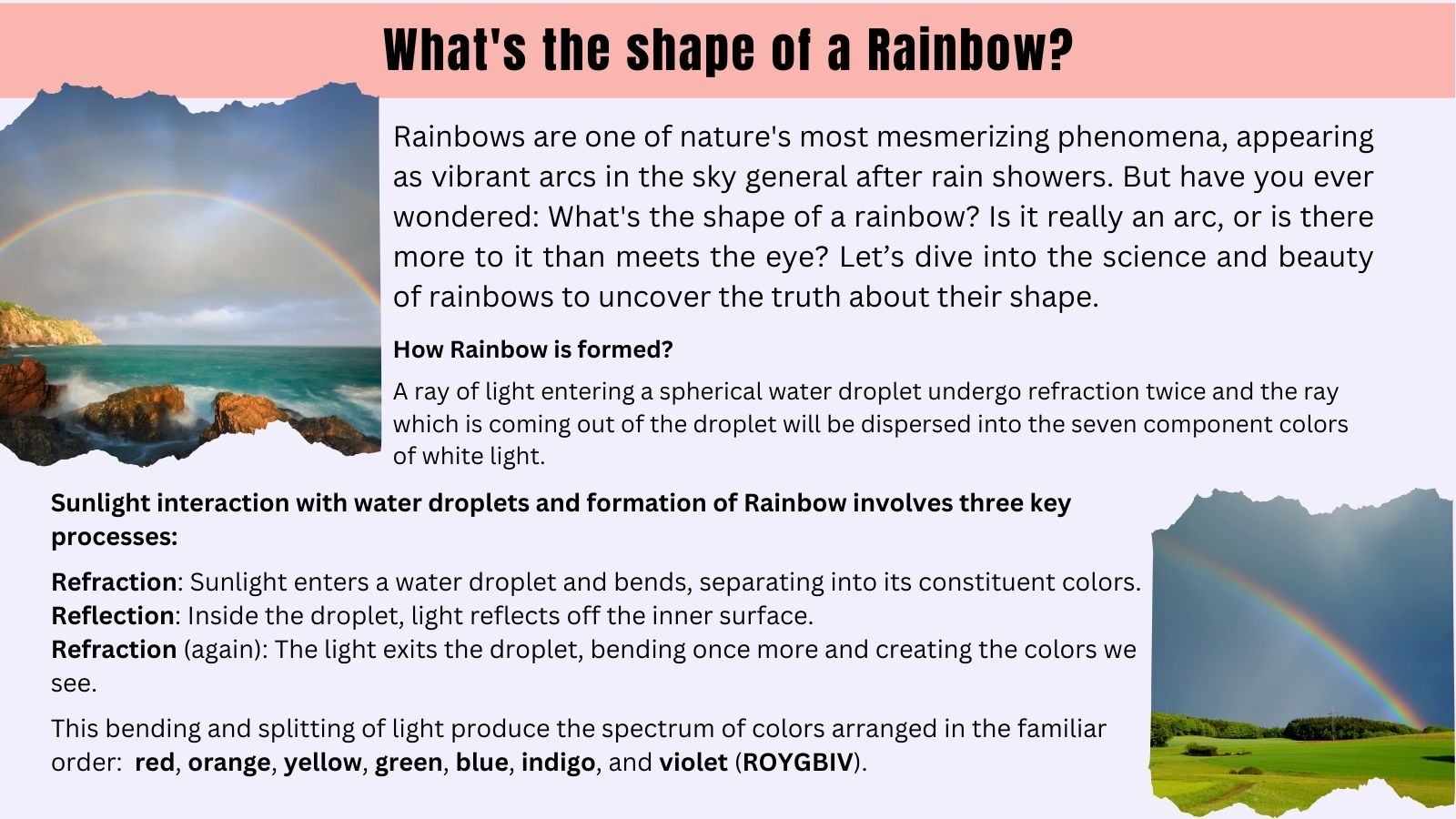
Before we discuss What’s the shape of a Rainbow?, it’s essential to understand that how a rainbow is formed. The Rays of a light undergo refraction two times when enters a spherical water droplet and get dispersed into seven component colors of the white light.
Sunlight interaction with water droplets and formation of Rainbow involves three key processes:
- Refraction: Sunlight enters a water droplet and bends, separating into its constituent colors.
- Reflection: In this process the light reflects off the inner surface of the droplet.
- Refraction (again): The light exits the droplet, bending once more and creating the colors we see.
The bending and splitting of light in droplets produce the spectrum of colors arranged in the familiar order: red, orange, yellow, green, blue, indigo, and violet (ROYGBIV).
Generally after a rain shower Rainbow is formed due to refraction of light rays in water droplets. In this water droplets act like a prism and a beautiful Rainbow is formed.
What’s the shape of a Rainbow?
Rainbows are one of nature’s most mesmerizing phenomena, appearing as vibrant arcs in the sky general after rain showers. But have you ever wondered: What’s the shape of a rainbow? Is it really an arc, or is there more to it than meets the eye? Let’s dive into the science and beauty of rainbows to uncover the truth about their shape.
Why Do Rainbows Appear as Arcs?
Rainbows are commonly seen as arcs because of the geometry of light and the way we perceive it. Each water droplet contributes to a specific color at a particular angle, usually about 42 degrees from the direction opposite the sun. The collective result of millions of droplets at this precise angle forms a circular pattern of colors.
However, from the ground, we only see a portion of this circle – the arc. The horizon blocks the rest of the rainbow, making it appear as a semi-circle.
The True Shape of a Rainbow
If you were to view a rainbow from a high vantage point, such as an airplane, you’d see its true shape: a complete circle. This is because, from the air, there are no obstructions like the horizon to block the lower part of the rainbow. The full circular shape is a testament to the symmetrical way light refracts and reflects within water droplets.
This phenomenon is why rainbows are often referred to as circular rainbows in scientific discussions, even though we typically observe them as arcs from the ground.
Some Facts About Rainbows
- Double Rainbows: Sometimes, we see a second, fainter rainbow above the primary Rainbow, which occurs when light reflects twice inside water droplets. The colors in this secondary rainbow are reversed, with red on the inner side and violet on the outer side.
- Supernumerary Rainbows: These are extra, faint rainbows that appear inside the primary arc, caused by interference patterns of light waves.
- Moonbows: Rainbows can also occur in the night, which is formed by moonlight instead of sunlight. They are much fainter and often appear white to the human eye.
Why Are Rainbows So Fascinating?
Rainbows have inspired wonder and myths across cultures. In ancient folklore, they were often seen as bridges to the heavens or symbols of hope and promise. Scientifically, they are a beautiful demonstration of how light interacts with water, showcasing the intricate and precise workings of nature.
Conclusion
So, while Rainbow appears as an arc from the ground, true shape of Rainbow is a full circle. This beautiful, amazing natural phenomenon combines the beauty of color with the precision of science, making it one of the most beautiful and sights in the world. When next time you spot a rainbow, remember that you’re only seeing half of the story – the rest of its dazzling circle is just waiting to be discovered by you. Is not is amazing !!! ?


 Pin It




![Taxmann’s Bharatiya Criminal Laws – Bare Acts [Hindi] COMBO [Bharatiya Nyaya Sanhita (BNS) | Bharatiya Nagarik Suraksha Sanhita (BNSS) | Bharatiya Sakshya Adhiniyam (BSA)]](https://www.yogiraj.co.in/wp-content/uploads/2026/05/Taxmanns-Bharatiya-Criminal-Laws-–-Bare-Acts-Hindi.jpeg)
![Taxmann’s Criminal Laws Combo [Diglot Edition] – Bharatiya Nyaya Sanhita (BNS) | Bharatiya Nagarik Suraksha Sanhita (BNSS) | Bharatiya Sakshya Adhiniyam (BSA)](https://www.yogiraj.co.in/wp-content/uploads/2026/05/Taxmanns-Criminal-Laws-Combo.jpeg)