Plant Cell
by Yogi P - April 25, 2025
The Amazing World of Plant Cells: A Closer Look at Nature’s Tiny Factories
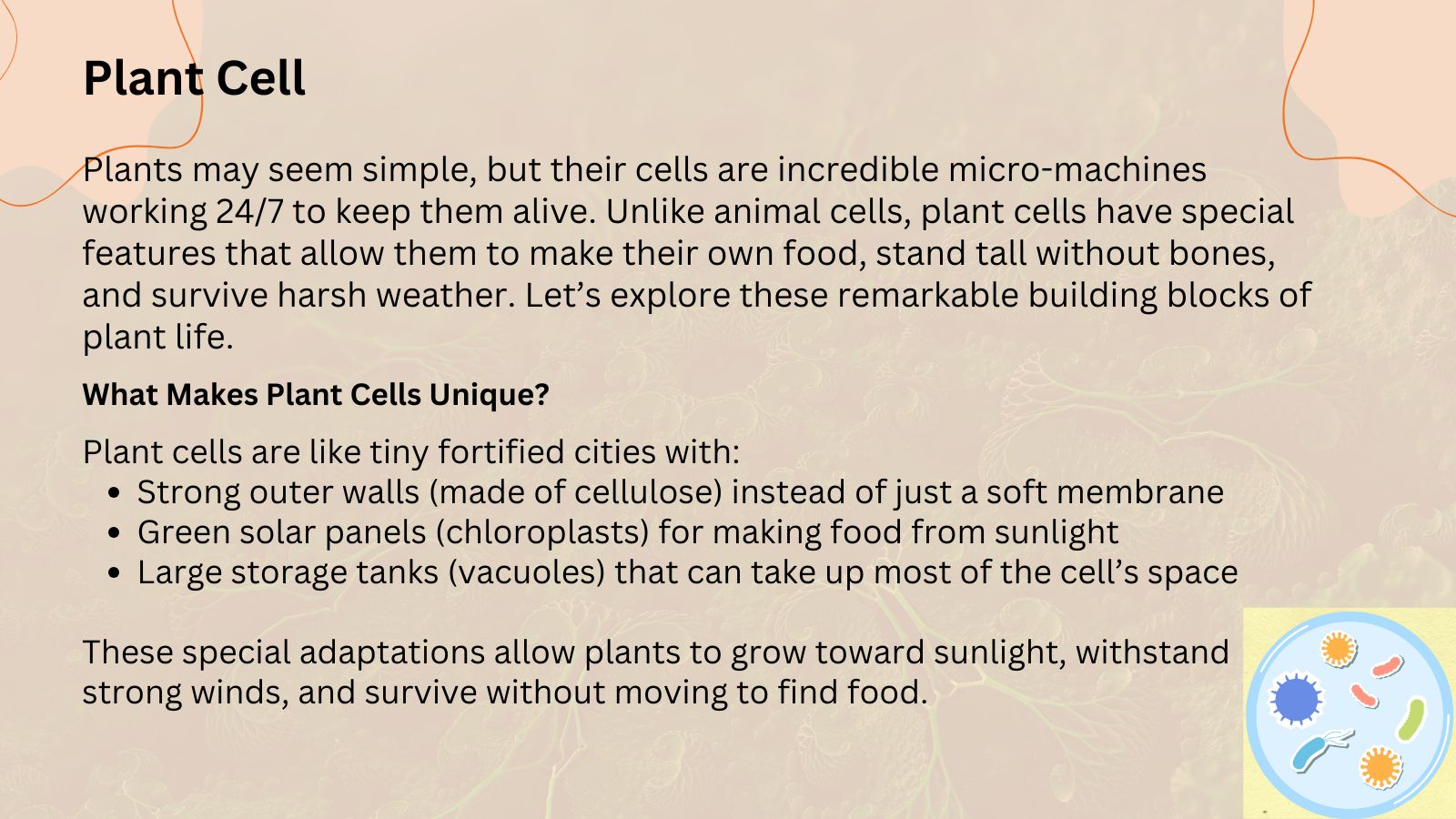
Plants may seem simple, but their cells are incredible micro-machines working 24/7 to keep them alive. Unlike animal cells, plant cells have special features that allow them to make their own food, stand tall without bones, and survive harsh weather. Let’s explore these remarkable building blocks of plant life.
What Makes Plant Cells Unique?
Plant cells are like tiny fortified cities with:
- Strong outer walls (made of cellulose) instead of just a soft membrane
- Green solar panels (chloroplasts) for making food from sunlight
- Large storage tanks (vacuoles) that can take up most of the cell’s space
These special adaptations allow plants to grow toward sunlight, withstand strong winds, and survive without moving to find food.
Plant Cell Blueprint: Key Structures and Jobs
The Cell Wall
-
Structure: Rigid outer layer made of cellulose fibers
-
Function:
✅ Gives the cell its box-like shape
✅ Protects against pests and diseases
✅ Acts like a plant’s “skeleton” to support tall growth
Chloroplasts (The Food Factories)
- Contain green chlorophyll that captures sunlight
- Convert sunlight, CO₂, and water into sugar through photosynthesis
- A single leaf contains about 500,000 chloroplasts per square millimeter!
The Central Vacuole
- Takes up 90% of the cell’s space in mature plants
- Stores water, nutrients, and sometimes poisons to deter animals
- Acts like a water balloon to keep plants firm (turgor pressure)
Other Important Parts
- Nucleus: The cell’s “brain” storing DNA instructions
- Mitochondria: Power plants that release energy from sugars
- Golgi Apparatus: The cell’s “post office” packaging materials
Specialized Plant Cell Types
| Cell Type | Special Features | Role in the Plant |
|---|---|---|
| Parenchyma | Thin walls, alive at maturity | Photosynthesis, food storage |
| Collenchyma | Flexible thick walls | Supports growing stems and leaves |
| Sclerenchyma | Very thick, rigid walls | Makes nutshells and peach pits hard |
| Xylem | Dead when mature, hollow | Forms “pipes” to move water upward |
| Phloem | Living cells with pores | Transports sugary sap throughout plant |
Fun Fact: The world’s longest plant cells are cotton fibers, which can grow up to 6 cm long – that’s 3,000 times longer than most plant cells!
Why Plant Cells Matter in Daily Life
- Food production: Every fruit and vegetable comes from plant cells
- Oxygen supply: The oxygen in every breath you take was made by plant cells
- Materials: Wood, cotton, paper, and rubber all come from specialized plant cells
- Medicine: Many drugs (like aspirin) were first discovered in plants
Frequently Asked Questions
Q: How are plant cells different from animal cells?
Ans: Three big differences:
-
Plant cells have rigid cell walls (animal cells don’t)
-
They contain chloroplasts for photosynthesis
-
They have huge central vacuoles for storage
Q: Why don’t plants bleed when cut?
Ans: Their rigid cell walls protect them, and they don’t have blood vessels like animals. Instead, they have sap in specialized tube-like cells.
Q: Can plant cells move?
Ans: Unlike animal cells, most plant cells stay in one place. But some parts can move slowly, like sunflower heads tracking the sun.
Q: How do roots absorb water?
Ans: Special root hair cells act like tiny straws, with permeable membranes that let water in but keep out most harmful substances.
Try This Simple Experiment:
Place a piece of lettuce in salty water and fresh water. In salty water, the cells lose water and the lettuce wilts (you’re seeing the vacuoles shrink!). In fresh water, the cells plump up again.
Next time you see a plant, remember: every leaf contains millions of these microscopic powerhouses working together to support life on Earth! From the oxygen we breathe to the food we eat, we depend on plant cells every day.


 Pin It



![Taxmann’s Bharatiya Criminal Laws – Bare Acts [Hindi] COMBO [Bharatiya Nyaya Sanhita (BNS) | Bharatiya Nagarik Suraksha Sanhita (BNSS) | Bharatiya Sakshya Adhiniyam (BSA)]](https://www.yogiraj.co.in/wp-content/uploads/2026/05/Taxmanns-Bharatiya-Criminal-Laws-–-Bare-Acts-Hindi.jpeg)
![Taxmann’s Criminal Laws Combo [Diglot Edition] – Bharatiya Nyaya Sanhita (BNS) | Bharatiya Nagarik Suraksha Sanhita (BNSS) | Bharatiya Sakshya Adhiniyam (BSA)](https://www.yogiraj.co.in/wp-content/uploads/2026/05/Taxmanns-Criminal-Laws-Combo.jpeg)